Japanese Language Lab brings together educational games and tools for understanding learning progress. The project separates practice activities, storage of learning events, and experiments with learner models so each part can develop independently.
Learning Record Store
- Python
- FastAPI
- SQLAlchemy


The Learning Record Store is the Python backend for Japanese Language Lab. It receives learning events through a shared API so exercises can record progress without being tightly coupled to one application.
Events can describe practicing kana, answering a vocabulary prompt, or completing a lesson. Keeping them in a common format creates a basis for progress views, recommendations, and learner-model experiments.
Current Implementation
The repository is in an early active stage. FastAPI provides the typed HTTP API, and SQLAlchemy handles database persistence. The development setup uses uv for dependency and environment management, with pytest tests covering the API over HTTP.
The intended architecture separates learning activities from analysis. Practice tools submit records, the service validates and stores them, and dashboards or learner models consume the resulting history. This allows new experiments to share the same progress data.
Open Learner Model Simulator
- Python
- Plotly/Dash

The OLM Simulator explores how learner models respond to practice data. Open learner models make an educational system’s estimate of a learner’s knowledge visible to that learner. The simulator provides a test bed for implementing these models, simulating interactions, and examining how new evidence changes estimated mastery over time.
Bayesian Knowledge Tracing
The first implementation uses Bayesian Knowledge Tracing, or BKT. It treats mastery as a hidden state and updates its probability after each correct or incorrect response. Parameters describe prior knowledge, learning, guessing, and slipping.
The simulation separates the mastery-model logic from the interface so additional models can be compared against the same interaction scenarios in the future.
Interactive Dashboard
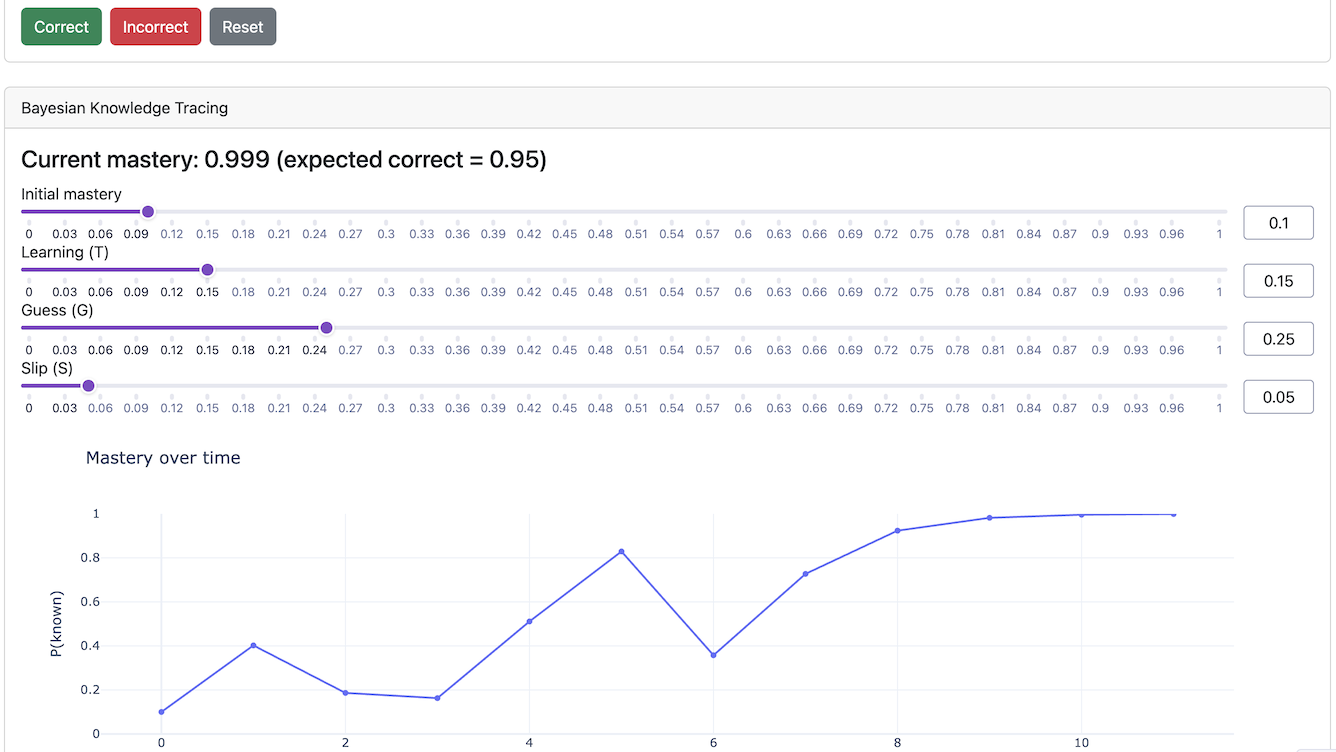
Plotly and Dash provide the Python interface and visualizations. Model parameters and simulated learner behavior can be varied while the resulting knowledge state is displayed, making it possible to examine assumptions before integrating a model into a learning application.
The dashboard supports local experiments without a separate JavaScript frontend or API service. It can help compare responses to noisy evidence, explore what an open learner model should show, and prototype explanations of learning progress.