I have a vivid memory of my 8th grade chemistry class. The teacher explained that bronze is an alloy and asked the class of which two elements it consists. I immediately knew the answer and raised my hand. Copper and tin. People looked at me in bewilderment, wondering how I could possibly know that. From World of Warcraft, of course.
I think about this a lot these days. It is fascinating to me that I learned something from a game, which I played without a second thought about learning.
Educational Video Games
There is a myriad of educational video games out there. Sadly, what’s wrong with most of them is in the definition of serious games found on Wikipedia:
A serious game or applied game is a game designed for a primary purpose other than pure entertainment.
The serious part, i.e., in the case of educational games, the learning, is the primary purpose. Consequently, the video game part is often an afterthought. This leads to the fact that these “games” are not as fun as other video games out there, causing potential students to favor those when deciding how to spend their time.
I fundamentally believe that games need to be fun first, before they can teach me anything. World of Warcraft didn’t try to teach me anything. I learned because I played the game; because the game was fun.
Why do good educational video games not exist? Well, they do. Wagotabi is a good example of one I saw recently. Admittedly, I am slightly mad at them for making the game I’ve been dreaming of making myself for over a decade now. But that’s besides the point. It is true that good educational games are rare. I believe there are two main factors why that may be the case.
Making Good Games Is Hard
This should not be a controversial statement. Dozens of new games are released every day on Steam alone but the average gamer doesn’t know about the vast majority of them because they are not worth the attention. That is not to say that most of those games are bad. They are just not great or do not capture a gamer’s attention long-term. Hence, many people gravitate towards the popular games they know are great.
Creating learning content is also hard. It is not enough to just know a topic well. The structure and content of a curriculum still takes a surprising amount of time and effort, as every educator can tell you.
Now combine the two and you have a nigh impossible task. The learning content has to be made in a specific way such that it can be integrated into a game, and in turn the game has to made such that it is possible to incorporate the learning content. For the greatest success, the two things are developed in tandem such that they seemlessly intertwine.
Difficulty: Impossible.
Potential Market
And yet, great games do exist. People who can make great games exist. Sometimes, even the money it takes is spent to do it. So, why does Rockstar Games decide to spend $2 billion on Grand Theft Auto VI instead of Duolingo – The Video Game? The answer is simple: way more people want to play GTA than an educational game X. There is 0 (zero) chance that this investment can be recuperated with an educational game.
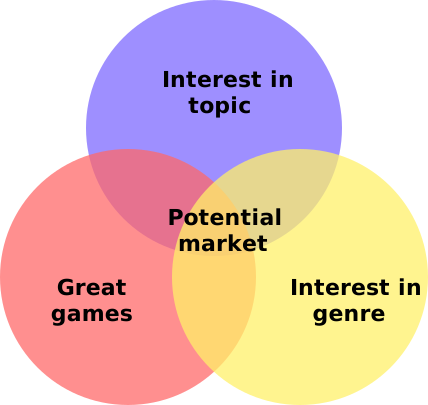
Why is that? After all, we are focusing on making an excellent video game first and foremost. However, the fact that it is an educational game can not be ignored. It is still a factor for the player when picking a game. The educational game will never be the first choice if someone is not interested in learning the topic taught in the game. Given the vast amount of topics people may be interested in, this fractures the market immensely. Likewise, the player needs to be interested in the game’s genre. This is less of a factor than the learning topic and the game’s quality, but even in the case of GTA VI, not everyone is going to play it. Consequently, the Venn diagram for the potential market looks quite bleak:
Conclusion
For the large investment necessary, there is very little money to be made in return. Capitalism will do its thing and good educational games have little to no chance of getting made. However, there is hope. As with the gaming industry at large, which is undergoing a transformation at the moment, the main driver for excellence will become passion. People will create good games because they love doing so. That is ultimately what drives me to try it myself. The Japanese Language Lab project is my long-term dream. I will slowly build it to possibly contribute to a future where people don’t have to endure the traditional education system and instead can learn while having fun. Because as soon as we stop having fun, what’s left?