I’m not exactly sure how to properly conduct a case study about a game. I will figure out the approach I want to take along the way and the next case study might look entirely different. The main thing I want to get out of these are some key takeaways for my own project Japanese Language Lab. What do I like about this game that I can potentially steal get inspired by? Which parts do I dislike and make sure to avoid.
I gave the game a bit more than 2 hours to get a good idea what it is about and how it works.
Story
The game starts out with your village getting attacked by “Hiragana Warriors”. The main character doesn’t know this “mysterious language”, but is soon introduced to Misaki, the Scholar, who explains that the way to defeat these creatures is to match the attack to the character they represent. She then proceeds to explain what Hiragana is and starts to teach the a-row in order to defeat the first combat encounter consisting of characters from the a-row.
I obviously have not finished the game yet, but the story seems to continue until all Hiragana characters are learned and the Hiragana Warrior invasion is cleared out. There are also side quests, which I have yet to explore for the most part. They are supposed to teach additional things next to the main storyline’s Hiragana goal. For instance, the first one teaches basic greetings.
Visuals
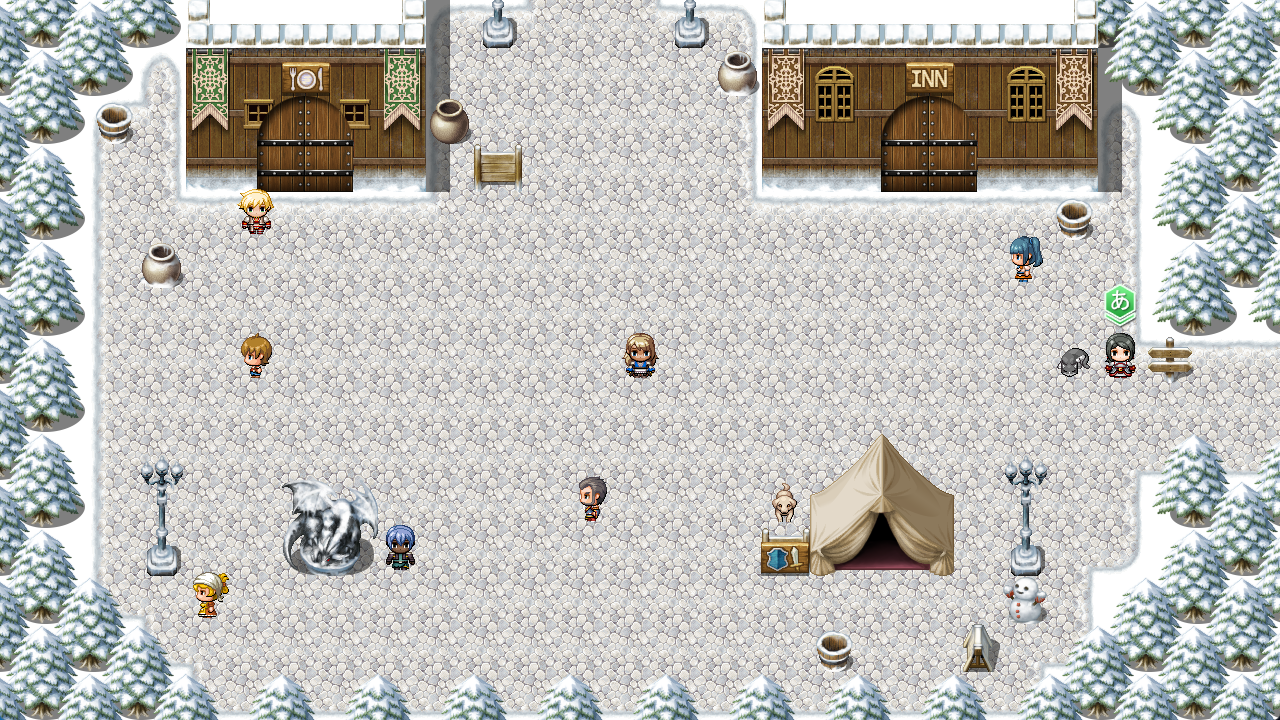
The pixel-art world and the manga-style portraits are great. In some places, the art looks somewhat disjointed, but overall, this is pretty much what I imagine when I think about my own game. I don’t have much more to say about this category; it looks good to me. Idk, google it, I am not an artist.
Sound
I started the game without sound, which is not an issue until the first vocabulary lesson. Then you don’t hear the pronunciation, but it still asks if you want to “hear it again”. It does not detect the lack of sound or warn the player ahead of time, nor is there a way to turn it on in the middle of the lesson. So, I completely missed it. This was my mistake and I will still note that it is very good that they have these pronunciation guides.
UI
The GUI is very inspired by classical J-RPGs like Final Fantasy. However, with mouse and keyboard, it is very unintuitive to use. A double-click is required to traverse the menu tree. The UI has to be set into a different mode by double-clicking on something instead of using hovers to adjust the view dynamically and single-clicks to get from A to B. Overall a pretty bad experience in this day and age.
Navigating the world can be done with the mouse or the keyboard. The default keyboard layout uses arrow keys instead of WASD, but there is a pre-configured WASD keyboard layout selectable in the settings. Mouse navigation is a bit more intuitive for world navigation, but it may be more convenient to use the keyboard to navigate the menus to evade the annoying double-clicking. This feels backward.
In combat, for some reason, it is not possible to target an enemy by clicking it. Instead, it has to be selected from the list in the GUI at the bottom of the screen. Again, not very intuitive.
Combat
There are random encounters when walking through the wilderness, reminiscent of Final Fantasy. There are also fixed encounters, usually for bosses and mini-bosses.
The combat is turn-based, where at the start of the round, the player determines the actions of each of your characters before the entire round plays out. Attacking works by choosing the right transcription for the target Hiragana. Not many details are shown about the current state of battle, missing critical information like the health of the enemies. When killing an enemy while having other characters queued to attack the same one, the attack will instead go to the next enemy, which is most likely a different Hiragana character, leading to the attack dealing 0 damage. This means the better strategy is to spread out the damage and live with the fact that you leave everyone alive in the first round.
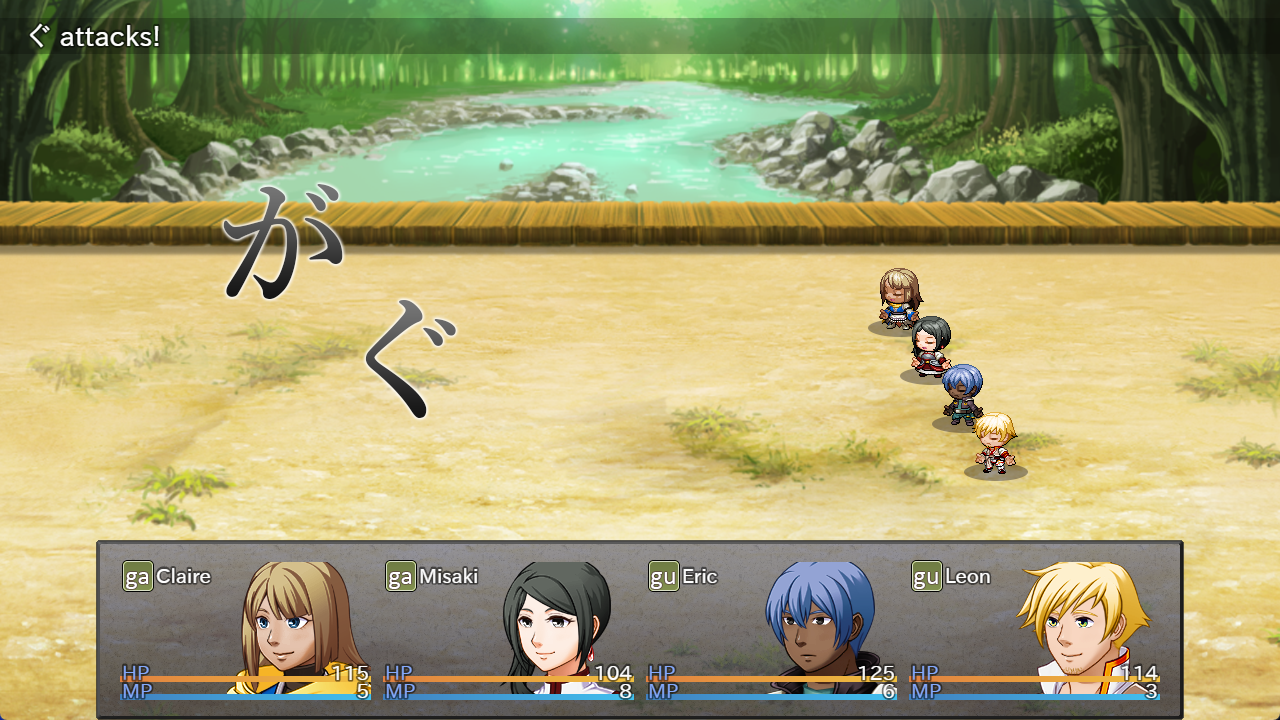
The end-battle screen shows the experience gained per character and the loot obtained. Again, visually very reminiscent of Final Fantasy.
Learning Content
The learning content is introduced rather slowly by forcing story progress first. It seems like the player can determine for themselves if a new lesson is in order or if they want to revise already introduced concepts. I would prefer a more directed approach, where the game actually manages my mastery and presents the best path forward.
The Hiragana characters are introduced with pronunciation guides and an animation to show the stroke order for writing. It does not contain any writing or pronunciation exercises, which most Japanese apps lack.
Despite the title stating that this game teaches Hiragana, there is also a small amount of vocabulary available. Mostly, this supports the Hiragana aspects by using the characters in real words. The scope is limited but it doesn’t try to hide it. There are also the accompanying Katakana War and Kanji Combat. I did not try those, but I assume they are pretty similar. They were released with a year in between, so they probably spent some time to give them new stories and other improvements. I might give them a look at some point, especially the most recent Kanji Combat, which looks the most sofisticated and teaches things I am not yet familiar with. Hence, I will be able to judge the learning content more accurately.
Interaction Between Game and Learning
There are some very nice elements teaching Japanese implicitly, such as using the Kanji for Yen as the currency. This is not explained, so I don’t know if people realize this, but it is a glimpse into what I like to see in a language learning game: usage of the language across the game, potentially unlocked after learning the corresponding concepts. Sadly, there is not enough of it. But at least for the vocabulary part, there is a progressive unlocking of hiragana representations based on the currently introduced characters.
The biggest missed opportunity for me is the world map, which is a complete fantasy world with the first village being “Snowleaf Village”. It would be a great addition to utilize a (stylized) version of Japan to additionally teach some geography and to teach, e.g., the Kanji of the actual city names. Of course, this game’s learning content is very limited, so these things are not necessarily within the scope.
The usage of Hiragana Warriors is forced to have some sort of way to interweave learning and gameplay. I feel it is not super effective to see 2 characters per combat and then just clicking on the same answer 4 times per round before you even know if it was correct. I might be a bit biased here because I already know Hiragana. It is possible that this makes more sense when you are actually learning and potentially have a trade-off, where you are between 2 possible answers and you can choose both with different characters and see what happens. I’m not so sure if this is a good idea.
The combat being so closely intertwined with the learning content limits the potential of the game quite severely. First, the story is forced down the road of utilizing the Hiragana Warriors throughout the game and I can’t imagine this being engaging all the way throughout. Additionally, with this system it is quite difficult to teach concepts outside of Hiragana. The vocabulary and greetings are mostly just taught through dialog as far as I can tell. This is not necessarily a problem because the game only really wants to teach Hiragana, but it is always a great benefit for an educational game, if the game and the learning content are a bit less coupled such that it is easier to add more content on either side without completely breaking everything.
Verdict
Learn Japanese To Survive – Hiragana Battle is a fun twist on learning. If you are currently starting your Japanese journey and you are having trouble with Hiragana in particular, this game can be a good addition to your regular curriculum. There are some great elements in here; enough to keep you going if you have the motivation to learn as well. It is, however, not quite enough to keep me motivated as a game alone.
As of today, the game is 5,99€ in Germany, but if you are interested in trying it and you can wait a few months, it goes on sale quite frequently. I actually bought it for 0,89€ during this year’s summer sale. I’m not sure if I would recommend the game at full price because of the usability issues, the forced story, and the limited learning opportunities of just Hiragana, which is far from enough to actually learn Japanese.