Proton therapy relies on the Bragg peak: protons deposit most of their dose near the end of their path. That behavior makes treatment precise, but it also makes verifying the stopping depth during treatment difficult. This research investigates whether a digital tracking calorimeter behind the patient can help verify that range by measuring secondary particles produced during treatment.
The work spans Monte Carlo simulations, silicon pixel detector response models, and machine learning methods that estimate beam range from detector readouts.
Range Prediction and Spot Rejection
- Python
- scikit-learn
- PyTorch



The proton-rv-dtc repository implements the method introduced in the paper Uncertainty-Aware Spot Rejection Rate as Quality Metric for Proton Therapy. It turns simulated detector readouts into features, predicts the proton stopping position and its uncertainty, and compares the result with the treatment plan.
The pipeline uses Python, SciPy, and PyTorch to:
- Generate detector features from Monte Carlo simulation output, and patient features from the phantom geometry.
- Train an uncertainty-aware neural network to estimate the Bragg peak position for each treatment spot.
- Reject spots when the measured and planned ranges disagree beyond the model uncertainty.
- Aggregate the rejection rate into a treatment quality metric that can reveal setup errors.
Data and Evaluation
The study uses over 70,000 simulated treatment spots across two anthropomorphic head phantoms, with 10 million primary protons per simulation. The repository includes configuration examples and scripts for feature generation, model evaluation, and runtime measurement.
In the published evaluation, patient-specific models predicted the stopping depth with a root mean squared error of 1.1 mm. The spot rejection rate detected 1 mm patient shifts after roughly 1,300 treatment spots on average.
Graph Neural Network Experiments
- Python
- PyTorch
- PyTorch Geometric
The proton-rv-gnn repository explores predicting proton range directly from spatial detector hits. It represents the readout as a point cloud and lets a graph neural network learn relationships between nearby hits. The experiment uses the same digital tracking calorimeter setting as the feature-based pipeline.
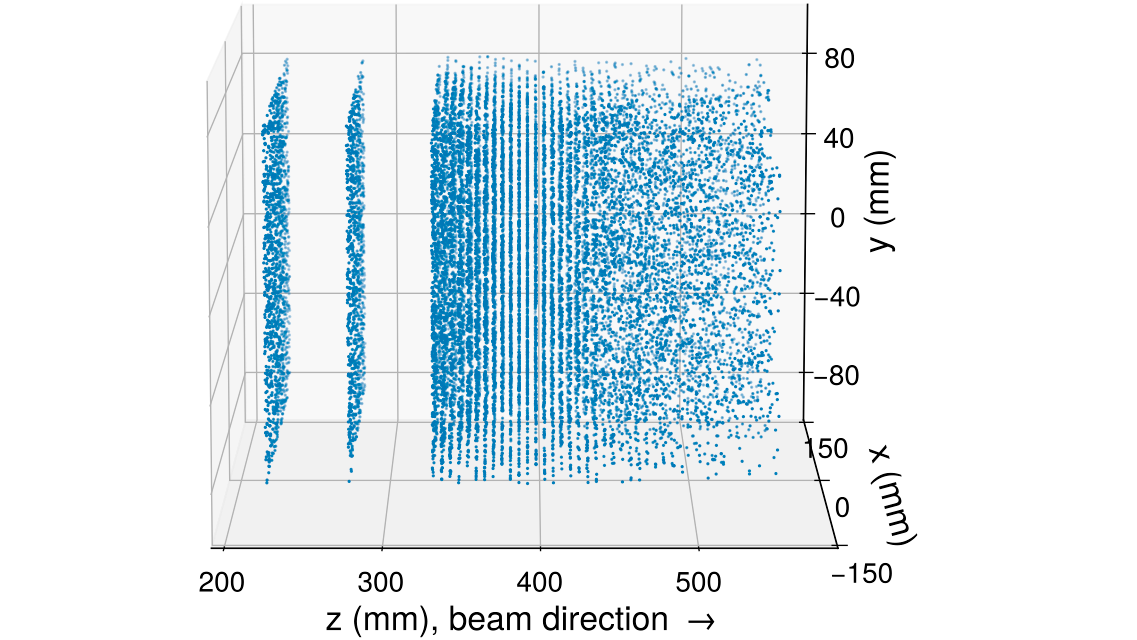
Detector hits become graph nodes with measured and spatial attributes, and graph edges capture local relationships in the point cloud. A configuration-driven runner trains and evaluates the models, with separate anthropomorphic phantoms providing training, validation, and held-out test data. The implementation uses PyTorch and PyTorch Geometric, and supports CPU and CUDA environments.
The graph-based approach did not outperform the manually engineered feature pipeline with the tested architectures and data. The code remains available as a documented research prototype so its approach, assumptions, and limitations can be inspected or extended.
Detector Response Modeling
- Python
- NumPy
- PyTorch

GATE and Geant4 provide the Monte Carlo simulations of particle transport and detector response used in this work.
The paper Modeling Charge Collection in Silicon Pixel Detectors for Proton Therapy studies how the response of silicon pixels affects proton imaging and range verification. This work connects the simulated detector signal to the performance of downstream reconstruction and range prediction tasks.
Reproducibility
The results were produced with simulated phantom data for the 715-HN phantom from CIRS Inc. and the Visible Human Female Head from the Visible Human Project. Both range-verification approaches use the same simulation dataset. The data and extracted features are available via Zenodo:
- Raw simulation data:

- Generated feature sets:
