 Python
 SciPy
SciPy
 PyTorch
Overview
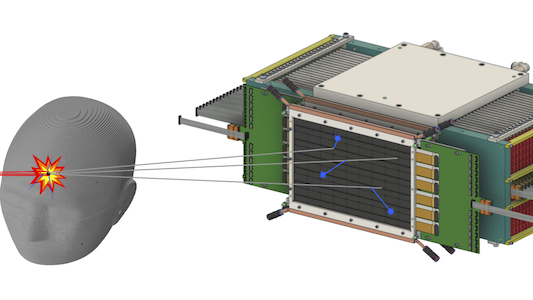
Proton therapy relies on the Bragg peak: protons deposit most of their dose near the end of their path. That behavior makes treatment precise, but it also makes verifying the stopping depth during treatment difficult. This research project evaluates whether a digital tracking calorimeter positioned behind the patient can provide an in-beam signal for range verification.
The software is the continued implementation of the method introduced in the publication Uncertainty-Aware Spot Rejection Rate as Quality Metric for Proton Therapy. It turns simulated detector readouts into features, predicts the proton stopping position and its uncertainty, and compares the result with the treatment plan.
How It Works
- Generate detector features from Monte Carlo simulation output and the patient or phantom geometry.
- Train an uncertainty-aware neural network to estimate the Bragg peak position from each treatment spot.
- Reject inconsistent spots when the measured and planned ranges disagree beyond the model uncertainty.
- Aggregate the rejection rate into a treatment quality metric that can reveal setup errors.
Data and Evaluation
The study uses over 70,000 simulated treatment spots across two anthropomorphic head phantoms, with 10 million primary protons per simulation. The repository includes configuration examples and scripts for feature generation, model evaluation, and runtime measurement.
In the published evaluation, patient-specific models predicted the stopping depth with a root mean squared error of 1.1 mm. The spot rejection rate detected 1 mm patient shifts after roughly 1,300 treatment spots on average.
Reproducibility
- Source code and setup instructions
- Raw simulation data on Zenodo
- Generated feature sets on Zenodo
- Associated publication
The project is research software rather than a clinical device. Its results were produced with simulated phantom data and should not be interpreted as clinical validation.